


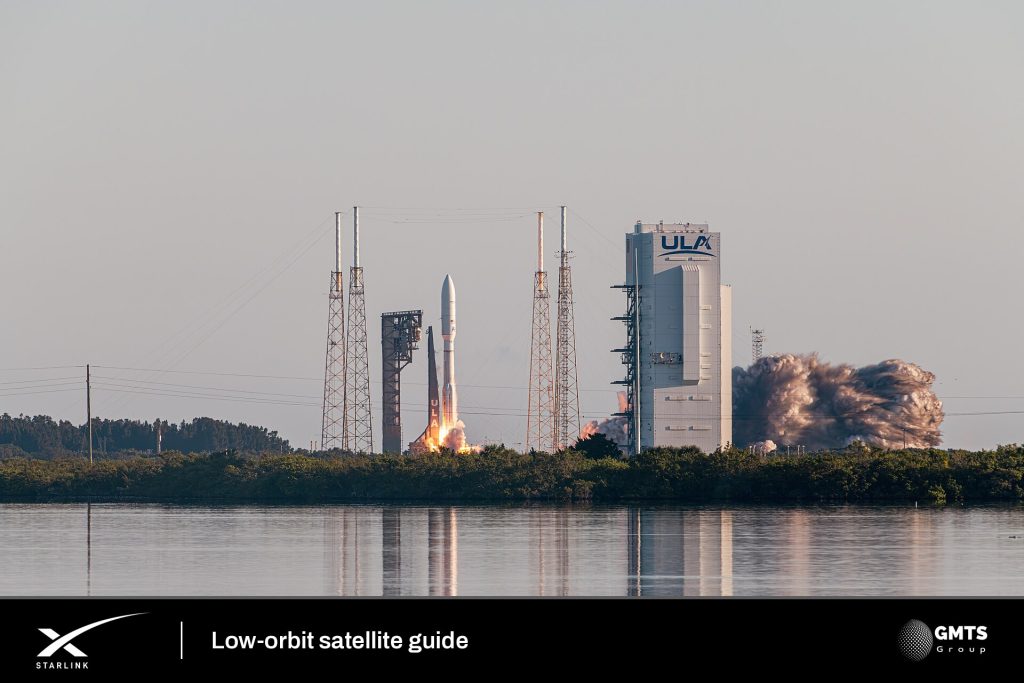
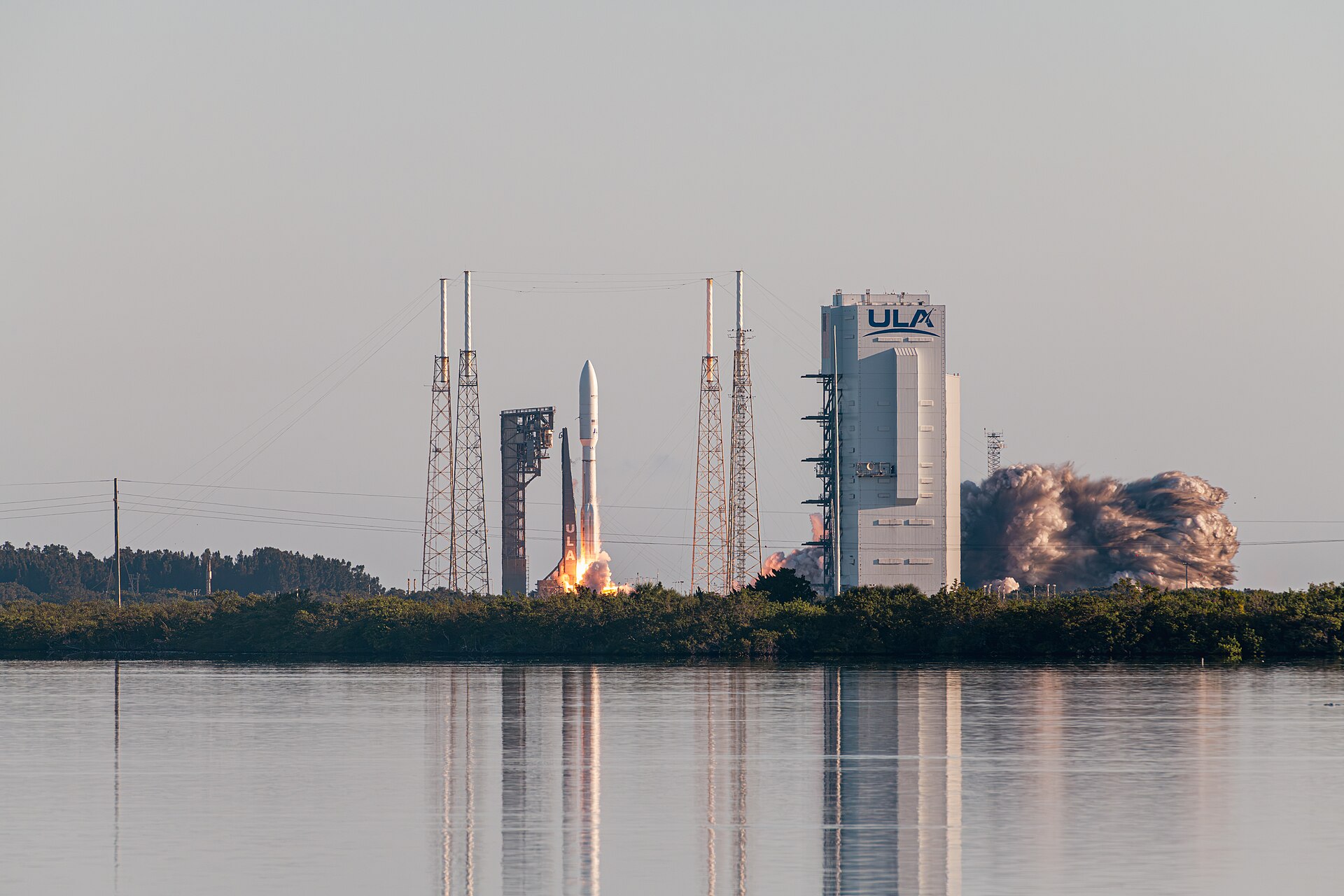
Photo: U.S. Space Force / Gwendolyn Kurzen (public domain), via Wikimedia Commons.
There’s a question we hear at least once a week now, from farmers, skippers and IT managers alike: “Should I wait for the next satellite service?”
It’s a fair question. Amazon says its Amazon Leo service is weeks away. Starlink keeps launching bigger, faster satellites. The headlines make it sound like everything is about to change.
So here’s an honest guide to the low-Earth-orbit (LEO) race: how it works, who’s who, and why our answer is nearly always the same.
How LEO internet works, and why it beats the old way
For decades, satellite internet meant geostationary (GEO) satellites, parked about 36,000 km above the equator. One satellite can cover a huge area, but the signal has a long way to travel. That’s why old satellite internet felt laggy, and why video calls were painful.
LEO constellations fly much lower, a few hundred to around a thousand kilometres up. The signal’s round trip is far shorter, so latency drops to something that feels like ordinary broadband. The catch is that each satellite only sees a small patch of Earth and races across the sky, so you need thousands of them, plus ground stations, to give continuous coverage.
That’s the whole race in a sentence: whoever gets enough satellites up, with enough ground stations behind them, wins.
Who’s who
Starlink (SpaceX). The incumbent, and the service we install every week. It covers New Zealand and its waters today for homes, vehicles, businesses and boats. Light Reading reports Starlink has now deployed 52 of its larger “V3” satellites, the latest 26 from Starship’s fifteenth flight, which also saw SpaceX catch Starship’s upper stage for the first time.
Eutelsat OneWeb. A LEO network aimed mainly at businesses, governments and mobility, sold through partners rather than direct to households.
Amazon Leo. The newcomer, and the one generating headlines. Fierce Network reports Amazon has nearly 400 satellites in orbit, more than 1,000 built, and says it will begin service “in the coming weeks” in select areas. Earlier this year it said initial coverage would target particular latitude bands in the northern and southern hemispheres. It had originally aimed for mid-2026.
It hasn’t been smooth. On 15 November (US time), a ULA Vulcan rocket carrying 40 Amazon Leo satellites failed to reach orbit. ULA’s preliminary findings point to inadequate fuel supply to the booster’s engines. Vulcan was meant to launch more than 1,500 of Amazon’s satellites over 38 missions.
The next batch was booked on Ariane 6. Arianespace scheduled mission VA271, carrying 36 Amazon Leo satellites, for 23 November 2026 at 11:09 UTC, which is 12:09am NZDT on Tuesday 24 November. Launch dates slip, so check Arianespace for how it went.
What about New Zealand? We haven’t seen Amazon announce a New Zealand launch date. Until it does, and until there are prices, terminals and support here, it isn’t something you can plan a farm or a passage around.
What V3 satellites change, and when
Starlink’s V3 satellites are much larger and add far more capacity per satellite. But they need Starship to get them up, and they need numbers to make a difference. SpaceX President Gwynne Shotwell has suggested a “few hundred” V3 satellites are needed before customers “really feel the impact” in speed, and that could happen by mid-2027, according to Light Reading.
So: good news for capacity over the next year or two. No change to what your dish does this week.
What you can buy and install in NZ today
Right now, in New Zealand, the LEO service you can order, install, support and get airtime for is Starlink:
- Residential and Roam for homes, baches, motorhomes and work vehicles
- Local and Global Priority for businesses and boats that need priority on the network, in-motion use, or coverage beyond New Zealand waters
- Maritime and Flat High Performance kits for vessels where motion, spray and a proper mount matter
We supply the hardware and the airtime, including Global and Regional Priority plans, and we install it properly.
How we pick a service
Our honest rule: install what works now, design for what’s next
– Choose on today’s coverage, support and price, not on a launch announcement.
– Put a multi-WAN router at the edge. A Peplink router lets you run Starlink and cellular today and add another service later without ripping anything out.
– Keep a second path. Cellular near the coast or town; Iridium for boats heading offshore.
– Revisit once a year. If a new service lands in New Zealand and genuinely suits your site, we’ll tell you, and the router will be ready for it.
So, should you wait? If you’ve got a connectivity problem today, waiting costs you months of bad internet for a service that hasn’t launched here yet. Our advice: solve it now, and build it so you’re ready for whatever comes next.
Talk to the team
Weighing up your options? Talk to us or book a time. See Starlink for boats, Starlink on land and our partners.
We’re a certified supplier and installer, and we can support you or your preferred installer onboard and ashore. Starlink airtime is also available with flexible plans and pool options.
Sources
- Amazon Leo on track for year-end service launch despite Vulcan explosion, Fierce Network. https://www.fierce-network.com/broadband/amazon-leo-track-year-end-service-launch-despite-vulcan-explosion (accessed 20 Nov 2026)
- Mission VA271: Launch window on November 23, 2026, Arianespace. https://www.arianespace.com/news/mission-va271-launch-window-on-november-23-2026/ (accessed 20 Nov 2026)
- Vulcan Leo 1 updates, United Launch Alliance. https://blog.ulalaunch.com/blog/vulcan-leo-1-updates (accessed 20 Nov 2026)
- SpaceX's Starship advances as Amazon Leo dealt fresh setback, Light Reading. https://www.lightreading.com/satellite/spacex-s-starship-program-advances-as-amazon-leo-suffers-another-setback (accessed 20 Nov 2026)